Skip the spec-sheet overwhelm. Here’s what actually determines the right bag for your material, and the four questions that cover almost everything.
.

Mark Moellman
Founder, InterBULK USA
9 min read
Start Here
Start with what’s going inside the bag, not the bag itself.
Most bulk bag problems start before the bag is ever ordered: they start with someone picking a bag first and figuring out the material second. Flip that around.
The material you’re filling determines almost everything else: how heavy a full bag will be, whether you need a liner, whether static is a concern, and how the bag needs to be shaped to move through your space.
Two materials that take up the same volume can weigh very differently. A cubic yard of sand weighs a lot more than a cubic yard of plastic pellets. That difference (bulk density) is why “I need a bag this big” isn’t enough information. We need to know what’s going in it before we can tell you what size and weight rating actually makes sense.
The Real Spec Conversation
Once we know the material, the spec conversation is short.
Four questions cover almost everything that goes wrong with the wrong bag: spills, rejected loads at the dock, bags that won’t stack, and bags that fail before the job’s done.
- How much will a full bag weigh, and does that match a Safe Working Load (SWL) the bag is actually rated for?
- Is the material a fine powder that needs a liner, or a coarse granule that doesn’t?
- Does the material carry any static or flammability risk that calls for an antistatic or conductive fabric?
- How will the bag move and stack (forklift, pallet, container), and does its shape need to hold up under that?
Answer those four and you’ve covered 90% of what goes wrong with the wrong bag.

Why It Matters
Three things that quietly drive the cost of getting it wrong.
None of these show up on a price-per-bag comparison, but they show up on the invoice eventually.
Price-First Buying Backfires
The cheapest bag that doesn’t match your material costs more in cleanup, rework, and rejected shipments than the few cents saved per bag.
Bulk Density Isn’t Optional Information
The same size bag can be safely full or dangerously overloaded depending on what’s inside: weight, not volume, is what the safety rating is built around.
The Right Shape Saves Space You’re Already Paying For
A bag that holds its shape stacks tighter on a pallet and in a container, more product per shipment, same freight bill.
A Quick Example
“Same bag as last time” isn’t always the right call.
Say a customer has been ordering bags for washed sand. The bag works fine: coarse material, no liner needed, no static concern, and the bag sits on a pallet in the yard until it’s used. The order is simple, and “same as last time” is a perfectly good answer.
Now the same customer adds a second product: a fine mineral powder that gets stored in the same size bag. On paper it looks like the same order. In practice, it isn’t. The powder will sift through the weave of a standard bag unless it’s lined, and depending on how it’s handled, it may also need an antistatic fabric. The bag that worked perfectly for sand could mean a dusty mess and a safety issue for the powder, even though the size on the spec sheet hasn’t changed.
This is the case for asking the four questions every time a material changes, even when the bag size doesn’t. A five-minute conversation about what’s going inside catches this before it becomes a cleanup, a rejected load, or a bag that fails on the way to the truck.
A liner isn’t the only way to solve a sifting problem like this. Coating the fabric itself, a thin polyethylene film applied to the woven polypropylene, closes the small gaps in the weave and keeps fine material from sifting through the body of the bag the way it would on uncoated fabric. That solves most of the problem, but not all of it: the stitching that holds the bag’s panels together still punches needle holes along every seam, and those holes can leak fine product just as easily as an uncoated weave can.
The fix for that is sift-proofing the seams themselves. A soft yarn or felt strip gets fed into the seam during sewing, filling the gaps the needle leaves behind instead of just closing the weave around them. For finer or higher-value products, that protection can be doubled or tripled, an extra layer of yarn or felt stitched into the same seam, so the bag still holds if one layer wears through. It’s a small detail to ask about, but it’s the difference between a coated bag that still leaks at the seams and one that actually holds a fine powder the way it’s supposed to.
Beyond the Big Four
Fill, discharge, and lifting setup matter just as much.
The four questions above cover the material. Once that’s settled, the bag’s mechanical setup, how it fills, how it empties, and how it gets moved, decides whether the bag works smoothly on your line or becomes a daily annoyance. A spout top keeps a narrow, closable opening for fine or dusty material going in; a duffle top opens the full width of the bag for faster or more flexible filling. On the bottom, a flat-bottom bag dumps its full load at once, which suits material that clumps or doesn’t flow freely, while a spout bottom with a closure (sometimes called a B-Lok) lets you control the discharge rate and keep dust down as the bag empties.
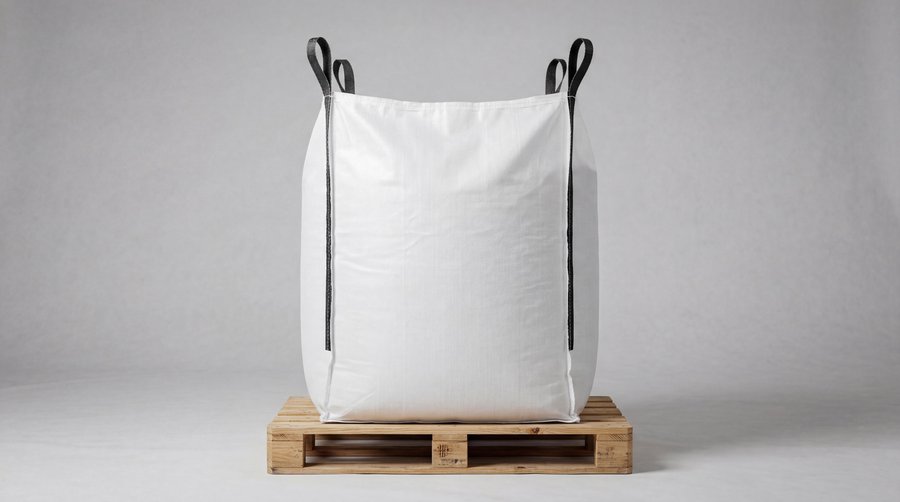
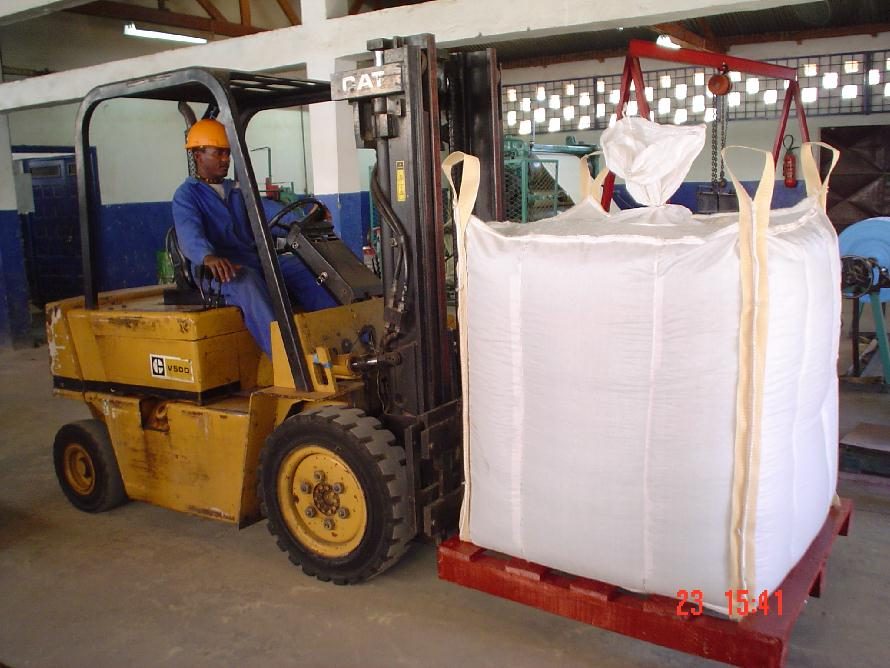
Lift loops matter more than they look, and the construction style decides which type a bag gets by default. Circular woven bags carry cross corner loops, sewn to form an arch over each corner, so all four loops stand upright on their own once the bag is filled, not unlike the Gateway Arch in St. Louis. That standing arch shape is what lets a forklift operator drive the forks straight through the open loops without anyone holding them in place first. U-panel bags, by contrast, almost always carry side seam loops instead. Those form more of a teardrop shape and tend to fall over once the bag is filled, the bunny-ears look, which usually means a second person is needed to lift and position the loops onto the forks before the bag can move.
One more practical detail worth asking about: how UV-treated the fabric is. Woven polypropylene typically includes a calcium carbonate filler for cost and strength, but published research on plastic stabilizers shows calcium carbonate actually reduces how well UV inhibitors protect the fabric, so the two can’t just be added together in any ratio and expected to work. If a project needs more UV protection than a standard mix provides, we can review the application and calculate the calcium carbonate and UV inhibitor balance around the outcome that actually matters: how the fabric looks, or how long it holds up under sun exposure over time.

Common Questions
What buyers ask before they place an order.
Straight answers to the questions that come up most before a first order.
What is the difference between an FIBC and a bulk bag?
None, they’re the same product. FIBC (Flexible Intermediate Bulk Container) is the formal industry and shipping term, and bulk bag is the everyday name most buyers use. Bulk sack means the same thing too. Super Sack is a registered trademark of United Bags, Inc., not a generic term, though some buyers use it informally to mean any bulk bag.
How much weight can a bulk bag hold?
Most standard bulk bags are rated to carry between 1,000 and 4,000 pounds (roughly 500 to 2,000 kg), with 2,000 lbs being the most common size ordered. The number that actually matters is the Safe Working Load (SWL) printed on the bag, not its physical size, since two bags the same size can be rated for very different weights depending on the fabric and construction.
Do I need a liner in my bulk bag?
It depends on what’s going inside. Fine powders like flour or cement typically need a liner because they sift through the small gaps in any woven fabric. Coarse granules and pellets usually don’t. If moisture or oxygen exposure is a concern for the product, a liner is worth it even for coarser material.
What's the difference between a U-panel and a circular woven bulk bag?
A circular woven bag is made on a circular loom as one continuous tube of fabric, which means it has almost no vertical seams, useful for fine or powdery products where seams are a leak risk. A U-panel bag is built from one U-shaped piece of fabric plus two side panels, which costs less to produce and works fine for general-purpose material.
Can a bulk bag be reused?
Standard bags carry a 5:1 safety factor and are built and tested for a single use. Multi-trip bags carry a 6:1 safety factor and are specifically designed, tested, and rated for reuse, with inspection required between trips. Reusing a standard 5:1 bag for a second load is not a recommended practice, since the bag was never tested or rated for it.
How long can a bulk bag sit in storage before it's filled?
Standard woven polypropylene holds up fine for normal short-term storage, but plastic degrades under UV exposure over time. If bags will sit outside in direct sun for more than a few weeks before use, ask your supplier whether the fabric is UV-stabilized, since unstabilized fabric left outdoors for months can lose strength before it’s ever filled.
Worth Thinking About
The quote request should start with the material, not the bag.
If you’re not sure which of the four questions above apply to your material, that’s exactly the conversation a quote request should start with.
Tell us what’s going in the bag, and we’ll tell you what bag makes sense, not just what’s cheapest.
Not sure which bag fits your material?
Send us what you’re filling and how it moves through your operation. We’ll recommend a bag that matches, not just the cheapest option on the sheet.